Psychosomatic Symptoms

Explores only child syndrome: what research really shows, distinctive traits like perfectionism and solitude, and where healing work often begins
23 September 2026
The only child has a complicated cultural reputation. Spoiled. Lonely. Unable to share. Overly dependent on adults. Socially awkward with peers. The popular image is not flattering, and it is also, according to the research, largely inaccurate. Only child syndrome is a term used to describe the cluster of characteristics, challenges, and psychological patterns associated with growing up without siblings. Like most psychological concepts that emerge from popular rather than clinical usage, it has been simplified, overapplied, and frequently misunderstood. This article examines what the research actually says, what is genuinely distinctive about the only child experience, and where the real psychological work, if needed, tends to lie, including how approaches like Family Constellation Therapy can help trace these patterns back to the family system.
The most comprehensive researcher on only children is psychologist Toni Falbo at the University of Texas at Austin. Her meta-analysis of over 200 studies on only children found that, on measures of achievement, intelligence, character, and sociability, only children performed comparably to or better than firstborns, and significantly better than later-borns. The stereotype of the spoiled, socially impaired only child was not supported. Only children scored higher on measures of self-esteem, achievement motivation, and academic performance. They were not found to be more selfish, less socially capable, or more maladjusted than children with siblings. What the research does find, more nuanced, and worth examining, is that only children tend to show certain distinctive characteristics that are neither pathological nor universal, but that reflect the specific developmental context of growing up as the sole child in a household.
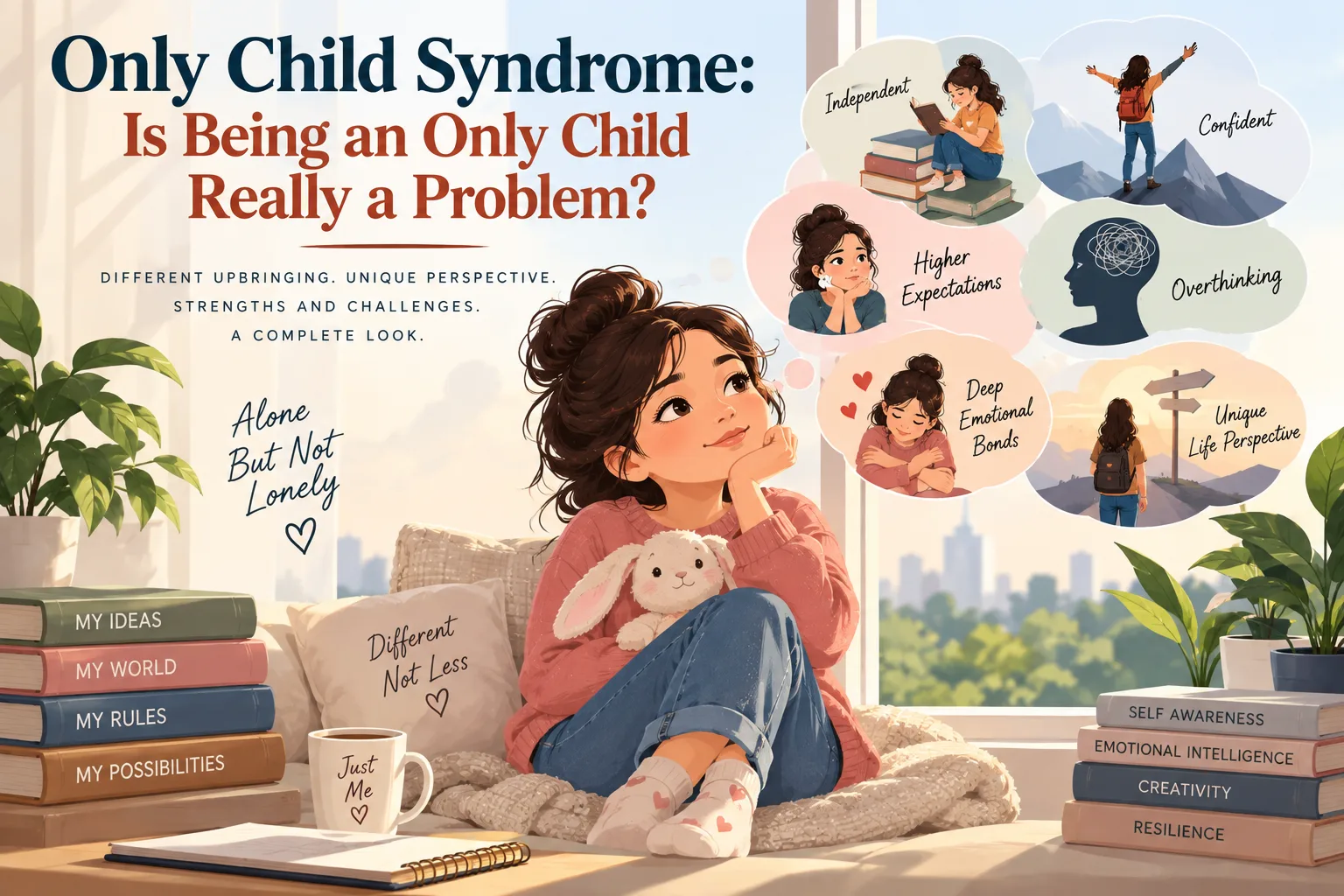
Sustained adult orientation : The only child lives in an almost entirely adult world throughout childhood. Their primary relational models, conversational partners, and experiential references are adults. This tends to produce a particular quality: comfort and fluency in adult contexts, a tendency toward adult-style communication, and sometimes a sense of disconnection from peer culture that can produce loneliness in childhood and adolescence. High internal standards : Without a sibling's performance to compare against, and without the dilution of parental attention and expectation that siblings produce, the only child often develops exceptionally high self-standards. Perfectionism, in the only child, tends to be self-generated and self-enforced. A developed relationship with solitude : The only child has had to develop internal resources, imagination, self-sufficiency, comfort with their own company, that children in sibships develop less intensively. This can be a significant strength, and it can also produce difficulty with the sustained social demands of peer relationships, teams, and partnerships. The full weight of parental projection : Every parent's hopes, anxieties, disappointments, and desires for their children land on a single target in the only child family. This can produce a child who is exquisitely attuned to what the parent needs them to be, and who has developed, sometimes at significant cost, the capacity to provide it. Particular aloneness : The only child has no sibling who shares the specific experience of being a child in that particular family, with those particular parents, in that particular household. In adulthood, this can produce a specific form of aloneness: the experience of having been the sole inhabitant of a family experience that no one else fully shares.
For only children who find themselves in therapy or therapeutic work, the most common themes are: The perfectionism that was formed in response to being the sole target of parental expectation, and the anxiety, rigidity, and difficulty with failure that tends to accompany it. The difficulty with the ordinary friction of intimate relationships: the negotiation, compromise, and imperfection that sibling relationships normalise and that adult relationships require. The complicated relationship with parental dependency: being the only child of ageing parents carries its own specific weight, and there is no sibling to share the practical and emotional burden of elder care. And, for some only children, a grief that has no obvious object: the grief for the sibling they never had, for the version of childhood that included someone who shared it, for the particular form of understanding that comes from being witnessed by someone who was there. Approaches such as Family Constellation Therapy can help trace how these inherited family patterns took root, and where they still show up in adult life.
Only child syndrome is a popular, non-clinical term for the cluster of traits and psychological patterns often associated with growing up as an only child, things like high internal standards, comfort with solitude, and a strong adult orientation, rather than a formal diagnosis.
No. Only child syndrome is not listed in any clinical diagnostic manual. It is a popular term used to describe a set of personality tendencies and developmental patterns that researchers have observed among only children, not a disorder or a diagnosis.
Research does not support this. Studies, including Toni Falbo's large-scale meta-analysis, found no evidence that only children are more selfish, spoiled, or poorly adjusted than children who grow up with siblings.
Not in general. Only children tend to be highly comfortable in adult and one-on-one settings, since most of their early relational experience is with adults. Some may find group dynamics, sharing, and peer negotiation less familiar early on, but this tends to even out with exposure, not persist as a lasting deficit.
With no siblings to share parental attention and expectation, the only child often becomes the sole focus of a family's hopes and standards. Over time this can turn into a self-generated, internalised pressure to perform and achieve.
They overlap but are not identical. Eldest children share some traits with only children, such as high responsibility and adult-oriented behaviour, but eldest children also learn to negotiate, compete, and share space with siblings in a way only children do not.
It can, for some. The ordinary friction, compromise, and conflict that sibling relationships help normalise in childhood is not automatically learned, so some only children encounter this learning curve later, within adult friendships or partnerships instead.
Therapy is not only for crisis. Many only children benefit from exploring patterns such as perfectionism, difficulty asking for help, or a quiet, unnamed grief around growing up without a sibling, even when day-to-day life is otherwise going well.
Approaches that look at family dynamics and inherited patterns, such as Family Constellation work, alongside individual therapy, can help only children understand how their family system shaped their standards, their relationship with solitude, and their sense of aloneness.
Being an only child is not, in itself, a problem to be fixed. The research is fairly consistent on this: only children are not more spoiled, less social, or worse adjusted than children with siblings. What is real, though, is a distinctive developmental context, one shaped by an adult-oriented childhood, undiluted parental attention, and a particular kind of aloneness that has no obvious peer to compare it against. For some only children, this context leaves behind patterns worth understanding: perfectionism, discomfort with the friction of close relationships, or a quiet grief for a sibling who never existed. None of these are signs of dysfunction. They are simply the shape a particular childhood leaves behind, and they can be gently explored and worked with.
Falbo, T. & Polit, D.F. (1986). Quantitative review of the only child literature. Psychological Bulletin, 100(2), 176–189. Sulloway, F.J. (1996). Born to Rebel. Pantheon. Leman, K. (1985). The Birth Order Book. Revell. Roberts, A. & Blanton, P.W. (2001). I always knew Mom and Dad loved me best. Journal of Counselling and Development, 79(2), 177–184. - Eldest Daughter Syndrome: The Complete Guide | Eldest Child vs Only Child Syndrome If birth order patterns are something you'd like to explore, book a session at The Healing Room.