Family Patterns

Feeling like the family's emotional backbone? Eldest Daughter Syndrome explains the exhaustion, the guilt, and how Family Constellation can help.
By Sonali Mittra · 6 August 2026
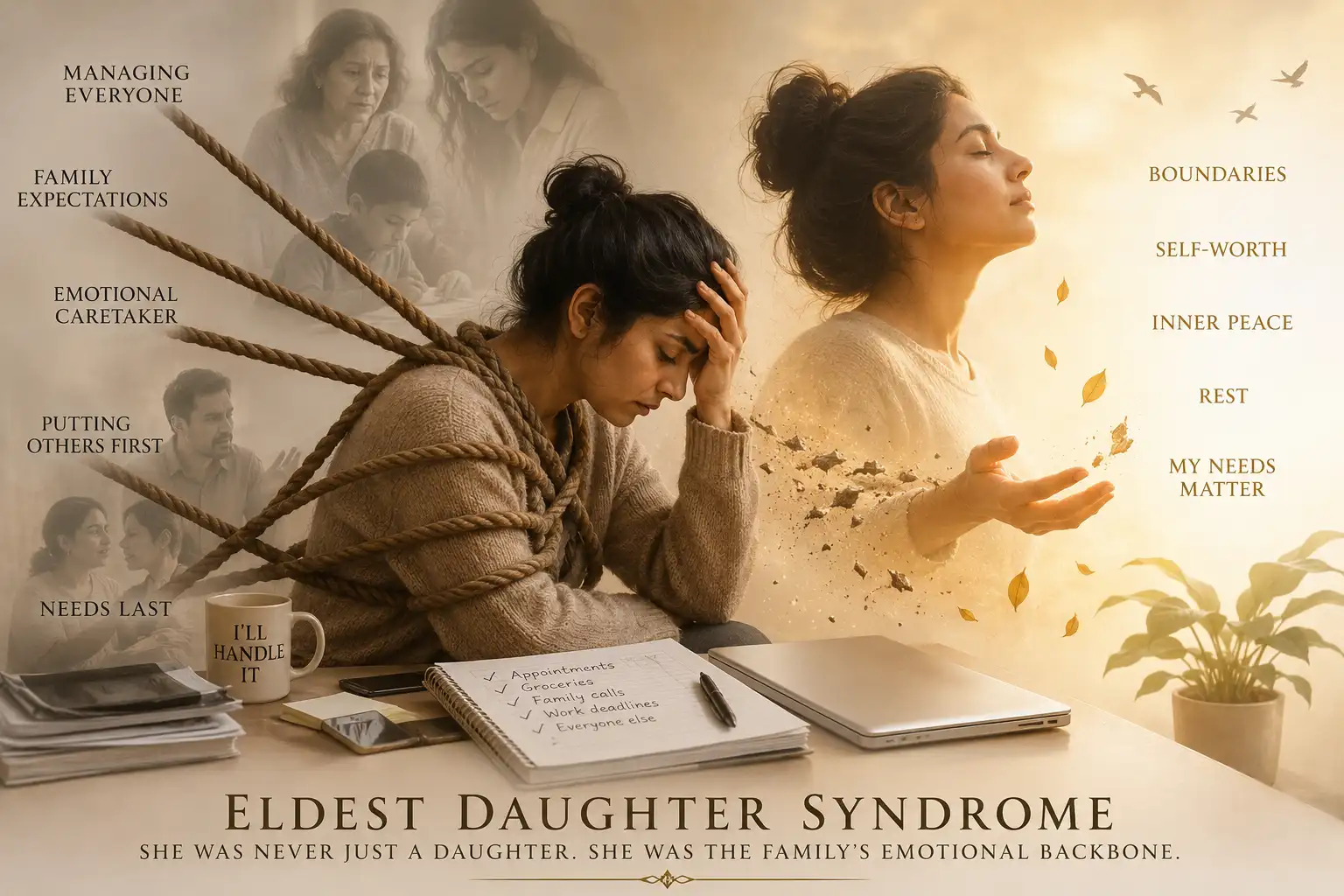
Priya is 34. She is successful, reliable, and the first person everyone calls in a crisis. At work, she manages her team with quiet efficiency. At home, she coordinates her parents’ medical appointments, mediates her younger siblings’ conflicts, and still somehow finds time to send birthday messages to every relative. She has not taken a real holiday in four years. She cannot explain why saying no feels physically dangerous. She does not know when she stopped having needs of her own, only that it happened a very long time ago. In Family Constellation work, women like Priya are often found standing in a place in the family that was never theirs to hold.
Priya is not a superhero. She is an eldest daughter living with what psychologists now call Eldest Daughter Syndrome — and she is exhausted in a way that sleep cannot fix.
Eldest Daughter Syndrome is not a clinical diagnosis. It is a pattern, named and increasingly recognised in psychology, that describes the particular emotional labour assigned to firstborn daughters in families. Unlike eldest sons, who are often granted authority, eldest daughters are typically assigned responsibility without power expected to nurture, mediate, manage, and hold the family together, emotionally, practically, and sometimes financially, often from a very young age.
This pattern is closely linked to what psychologists call parentification: a role reversal where a child takes on adult-level emotional or caregiving duties before they are developmentally ready for them.
The mechanisms that create this pattern are deeply embedded in family systems. When parents are overwhelmed by financial stress, marital tension, immigration, illness, or their own unprocessed trauma they unconsciously lean on the most capable child. In most family structures, that child is the eldest daughter. She is old enough to help, young enough to mould, and, crucially, she has learnt that being needed is how she is loved.
Research published in the Journal of Family Psychology found that firstborn children, and particularly firstborn daughters, score significantly higher on measures of conscientiousness, anxiety, and responsibility than their younger siblings traits shaped not by genetics, but by family role.
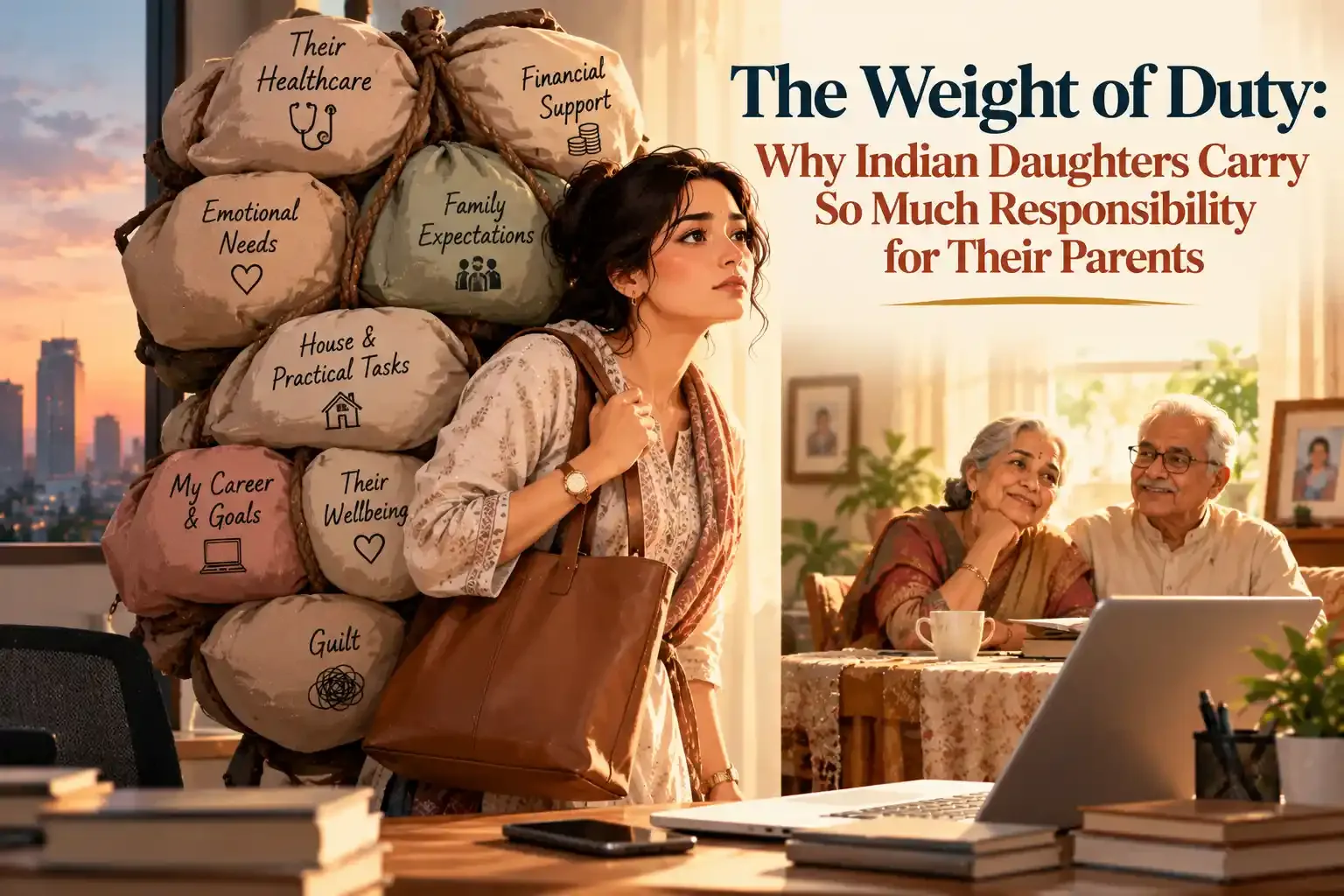
In many Indian families, ideas of duty, honour and being the “responsible daughter” add another layer. Eldest daughters are often expected to look after younger siblings, support ageing parents, keep the peace and still excel at work. Our article on why Indian daughters carry so much responsibility for their parents explores this in depth, and our post on sibling conflict over elderly parent care shows how it plays out later in life. If you are also raising children while caring for parents, read about the sandwich generation.
Not every firstborn daughter carries this pattern, and it can show up in second daughters or "default" caretakers too. Here is what it often looks like day to day:
The eldest daughter rarely sees her situation clearly, because the lens through which she views herself was grounded in childhood. She does not think I was parentified. She thinks I am just capable. She does not think, I was never allowed to need anything. She thinks I am not really a needy person.
This is the cruelty of the pattern: it disguises itself as character. The hyper-responsibility feels like virtue. The inability to rest feels like driving. The people-pleasing feels like kindness. It takes considerable courage to look beneath the identity and ask: what did I have to become, in order to be safe in this family?
The same helper pattern can also show up as a need to rescue others, which we explore in the saviour complex, and in feeling responsible for everyone.
The physical toll of carrying this role is real and well-documented. Eldest daughters present in therapy and healing spaces with a strikingly consistent set of symptoms: chronic fatigue, anxiety, difficulty sleeping, tension in the shoulders and neck, digestive issues, and an immune system that crashes the moment they finally stop moving.
The body, which has been running on duty and adrenaline for years, does not know how to shift gears when the coast is clear. Rest feels irresponsible. Stillness feels dangerous. The nervous system, tuned to vigilance, can stay on high alert even when things are safe. Our guides to psychosomatic symptoms, caregiver burnout and burnout in women go deeper into this.
A 2019 study in Psychological Science found that individuals who were parentified in childhood given adult emotional responsibilities prematurely showed significantly elevated cortisol levels and greater reactivity to stress in adulthood
In Family Constellation work, the eldest daughter often appears in the same systemic position: standing in for a parent, carrying emotions that belong to someone else, unable to take her own place in the family order because she has been occupying someone else's. The work is not about blaming the family. It is about making visible what has been invisible, so that she can, perhaps for the first time, simply be a daughter.
The moment that moves clients most in the constellation is often simple: when they are given permission to put down what they have been carrying and step back into the child's position. Many weep. Not from sadness exactly, but from the shock of relief of finally being small enough to be held, rather than large enough to hold everyone else.
Healing from Eldest Daughter Syndrome is not about becoming selfish. It is about becoming whole. It involves learning to distinguish between what is genuinely yours to carry and what was placed on you before you were old enough to consent. It involves, slowly, building a relationship with your own needs, which have not disappeared, only gone underground. For many women, this begins with reconnecting with the inner child who learned to stay quiet and capable so that everyone else could be okay.
It means practising the radical act of receiving help, rest, care, love without immediately looking for how to repay it. It means understanding that your value is not contingent on your usefulness. That you were not born to be the family's emotional infrastructure. That somewhere beneath the capable, reliable, endlessly available woman is a girl who also needed someone to ask how she was doing.
"You cannot pour from an empty vessel. But you also deserve to be a vessel that is filled."
A few simple lines can help with family: “I love you, and I can’t do this one.” “Can you take this on? I’d appreciate the help.” “I need to rest today, I’ll call you tomorrow.” If the system around you has been built around your over-functioning, expect some pushback at first. It usually settles as everyone adjusts. For a deeper look at repairing family relationships, read our guide to family healing, and our post on the family scapegoat if your boundaries are met with blame.
Eldest Daughter Syndrome describes a pattern in which the firstborn daughter takes on excessive emotional and practical responsibility in her family, often from a young age. She becomes the caretaker, mediator and organiser, and may struggle to rest, say no or recognise her own needs.
No. It is not a clinical diagnosis. It is a pattern that many therapists and psychologists recognise, closely linked to parentification, where a child takes on adult responsibilities too early. If it is affecting your health or daily life, a mental health professional can help.
Common signs include feeling responsible for other people’s emotions, not being able to rest without guilt, struggling to say no, being the family’s default organiser, and finding it hard to name what you want or need.
It usually develops when parents are overwhelmed by stress, illness, financial pressure or their own unresolved pain and lean on the most capable child. Cultural expectations of duty and caregiving can strengthen it. It is not limited to eldest daughters: sons, middle children and anyone cast as the default caretaker can carry a similar role.
Long-term stress and over-responsibility can show up as fatigue, tension, poor sleep, digestive problems and anxiety. These symptoms can also have medical causes, so it is important to speak to a doctor and not assume they are only emotional.
Start by noticing the role you play, practise small boundaries, share responsibilities, allow yourself to receive help and rest without earning it, and seek support from a therapist or counsellor. Reflective approaches such as inner child work and Family Constellation can help you separate what is yours to carry from what is not.
Family Constellation looks at your position in the family system. For eldest daughters, it often reveals how they have been standing in for a parent or carrying someone else’s emotions, and helps them step back into the position of a daughter. Research on the method is limited, so it is best used alongside professional care, not as a replacement.
Start small and keep your language kind and clear, such as “I can’t take this on this week.” Expect some discomfort and pushback at first, because the family has adjusted to your over-functioning. Guilt does not mean you are doing something wrong. It usually means you are changing an old pattern.