Family Patterns
You can see what is hurting you and still find it hard to leave. Here are 15 signs of a toxic relationship, and why powerlessness keeps people stuck.
15 October 2026
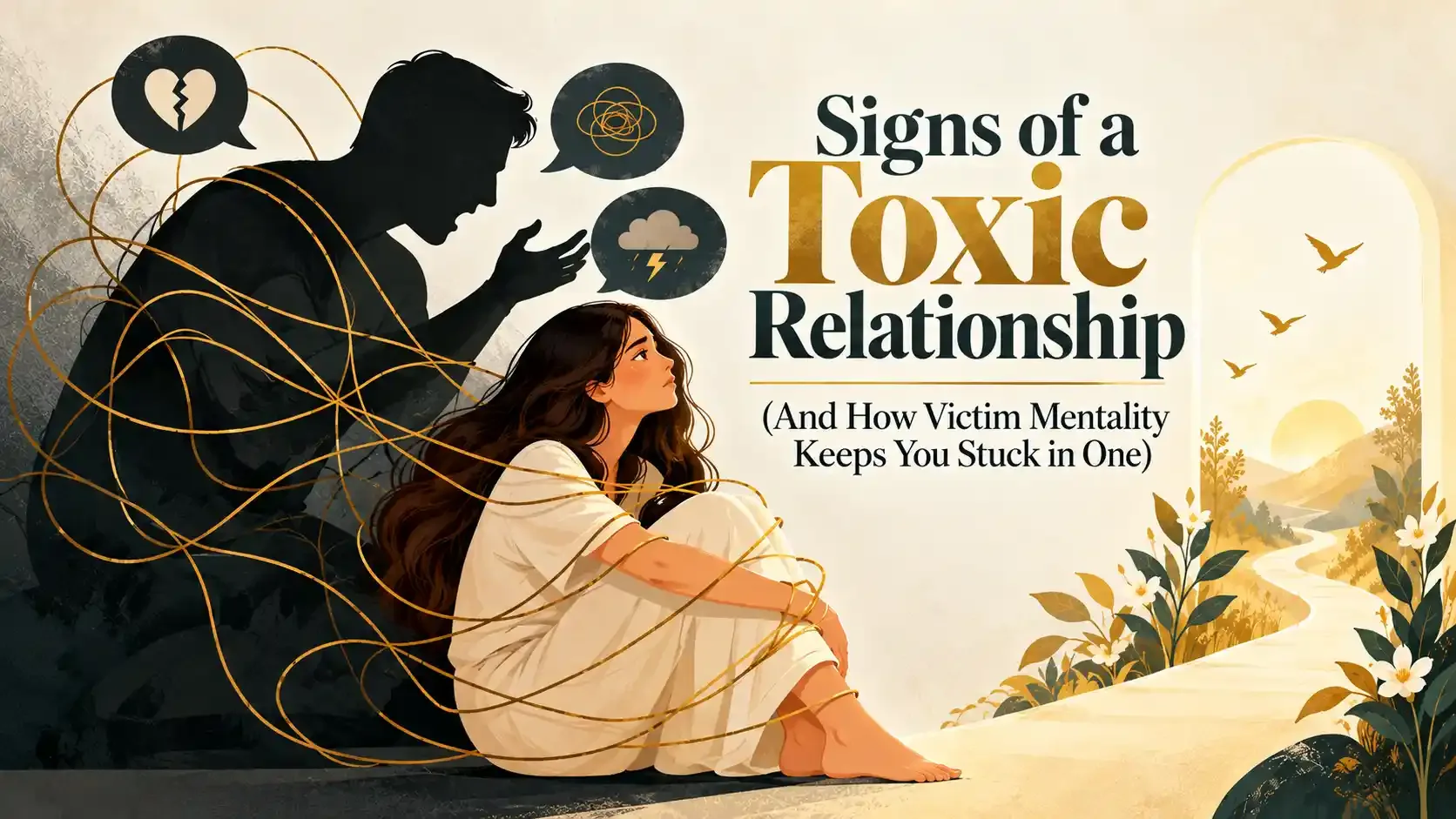
She knew. She had known for two years.
She could describe, with precision, every dynamic that was hurting her. The way criticism arrived dressed as concern. The way warmth disappeared the moment she expressed a need. The way she had slowly stopped talking about her work, her friendships, her inner life, because every conversation seemed to cost her something she could no longer afford to lose.
She knew. And she stayed.
“I don’t understand myself,” she told me. “I’m not a stupid person. I know what this is. Why can’t I leave?”
Why is it so hard to leave something you can clearly see is harmful? It is a question many people carry quietly, and the answer is rarely weakness, low intelligence or a lack of self-respect. It is usually more specific than tha`t.
This article looks at the signs of a toxic relationship, what separates it from an ordinary rough patch, and why a deep sense of powerlessness, often called victim mentality, can make leaving feel almost impossible. We will also look at how therapy, including family constellation therapy, can help you understand the pattern underneath. It applies whether the relationship is with a partner, a parent, a friend or another family member.
“Toxic” is an everyday word, not a clinical diagnosis. It is usually used for a relationship that, over time, leaves you feeling worse about yourself rather than better.
A toxic relationship is not simply a difficult one. Conflict, misunderstandings, growing pains and periods of distance happen in every close relationship. What sets a toxic one apart is the direction its effect takes over time.
In a healthy relationship, difficulties get worked through in ways that, on balance, strengthen the connection and support both people’s growth. In a toxic one, the pattern keeps wearing someone down, eroding trust, confidence, sense of self and wellbeing.
The word pattern matters. One unkind remark, or one bad week, does not make a relationship toxic. What matters is what keeps repeating, and its cumulative effect on how you see yourself and how well you can function.
You find yourself working harder to explain their behaviour to friends and family than they work to change it. It can feel like being a defence lawyer in a case that keeps reopening.
Their mood becomes your problem. Their sadness needs managing, their anger needs careful handling. You have become the main regulator of another adult’s emotional life, which is exhausting and not your job.
After a disagreement, you are unsure what actually happened. You wonder whether your memory is wrong or whether you are being too sensitive. When this happens regularly, it may be what people call gaslighting, and over time it wears down your ability to trust your own experience. An occasional difference in how two people remember something is normal. The repeated pattern is what matters.
Your opinions have softened. Topics you once discussed freely are now avoided. Friends have become occasional contacts, and ambitions have been quietly shelved. You may also find it hard to picture a future that does not revolve around this relationship. The edges of your life have shrunk to fit it.
Warmth arrives when you have pleased, complied or avoided trouble, and goes missing when you have not. Rewards that come on an unpredictable schedule can bind people more strongly to a relationship, which is one reason this pattern is so hard to walk away from.
You adjust what you say, how you say it and when you bring things up, based on constant monitoring of their mood. The relationship needs so much management that there is no room for ease.
When you ask for something, whether emotional, practical or relational, it is received as demanding, ungrateful or too much. Over time you stop asking. You become someone who does not need things, or who needs them in silence.
This is the counterintuitive sign. The relationship hurts, yet the thought of leaving frightens you more than staying does. That is not irrational. The familiar, even when painful, can feel safer than the unknown, especially if it echoes what you grew up with.
Remorse is expressed and promises are made, then the behaviour returns. The apology becomes a way of resetting the cycle rather than a step towards real change.
You do most of the giving, the repairing and the compromising. When you set a limit, it is ignored, mocked or punished.
Not just occasionally tired, but consistently hollow. The relationship takes more than it gives.
Headaches, digestive trouble, disturbed sleep. Chronic stress can show up in the body even while the mind is still explaining things away. These symptoms can have other causes too, so see a doctor, and notice whether they ease or worsen around this person.
Your dreams, fears, enthusiasms and spiritual life are dismissed, mocked, ignored, or simply never asked about. You exist in the relationship as a function, not as a whole person.
You edit what you tell the people who care about you, because you know the full story would worry them. This kind of concealment feels like loyalty, and it is worth looking at honestly.
Here is the test that cuts through everything else. Compare who you are at your best, in friendships, at work, in your relationship with yourself, with who you are inside this relationship. If the answer is consistently smaller, more fearful and less alive, the relationship is not supporting your life. It is diminishing it.
Some of the signs above, especially fear, control, threats, and being kept from friends, money or your phone, go beyond “toxic”. They can be signs of emotional or physical abuse, and that calls for a different kind of care.
If you feel afraid of the person, or you are being threatened or hurt, your safety comes first. In India, you can call 112 in an emergency, the 181 Women Helpline (24 hours, free) if you are a woman facing violence, or Tele-MANAS on 14416 for mental health support. Please also tell someone you trust.
Here is the connection this article is really about.
First, an important clarification. Victim mentality does not mean you are to blame for how you are being treated. Harm done to you is real, and the person causing it is responsible for it. The term describes a learned, often unconscious sense of powerlessness, usually built up for understandable reasons, that can make leaving harder than it needs to be.
That feeling, the habitual sense that outcomes are decided by forces outside your control, can live very stubbornly inside a toxic relationship. This is how it tends to show up.
The story of impossibility. “I can’t leave because of the children, the money, the family, what people will say, where I would go.” Some of these are real practical constraints and deserve to be taken seriously. The trouble starts when they become a closed door, and the conversation ends before it begins because impossibility has already been declared.
Attention stays on them. Most of your energy goes to what they should do differently, stop doing or become. That is understandable, because their behaviour is a real part of the problem. But when all the attention is on what they must change, the question of what you can do drops out. The one thing you can always influence is your own next step.
Familiarity feels like safety. People are often drawn to what is familiar, even when it hurts, because familiar feels predictable. Attachment research suggests our earliest relationships shape what feels normal later in life. Many people in toxic relationships grew up with similar dynamics, so the pattern may feel less like a trap and more like home.
Family Constellation therapy looks at this through a family-systems lens. Its practitioners see a painful present relationship as sometimes echoing an earlier family pattern, one followed unconsciously rather than chosen. For many people, seeing it this way eases the shame of “why did I choose this?” and opens a different question: do I want to begin choosing differently? It is a therapeutic framework rather than an established clinical treatment, and research on it is still limited, so it works best alongside, not instead of, professional mental health care.
An identity built around the relationship. Over time, the pain of a relationship can become part of how you see yourself. The story of what you have endured, how you were treated, what was done to you, carries weight and coherence, and the kind of meaning that suffering can give a life. Moving forward means being willing, in time, to loosen that story. That is not small, and it does not happen on demand. For some people it is the hardest part of the transition.
Whether to leave or stay is ultimately your decision, and it involves practical, financial, parental and emotional factors that no article can weigh for you. Leaving is also not the only possible outcome. Some relationships can change, though only when both people are willing and supported.
If you are staying in something harmful because leaving feels impossible, that feeling is worth examining closely. It is rarely as absolute as it seems, and the gap between how impossible it feels and how impossible it actually is, is where the work lives.
A few places to begin:
Understanding the pattern at its root can bring a different kind of movement from simply listing the relationship’s faults. Why did this dynamic feel familiar? What earlier template might it be echoing? What is the sense of powerlessness protecting?
You already know the deficits. You could list them. What you may not yet understand is why leaving feels so hard for you. That is the question worth sitting with, and it can be understood.
If this feels familiar and you would like to explore the patterns beneath it with guidance, you can book a Family Constellation session.