
Fear of Losing Parents

10 subtle victim mentality signs, why they form as childhood protection, and how curiosity and Inner Child work can help you reclaim agency
28 September 2026
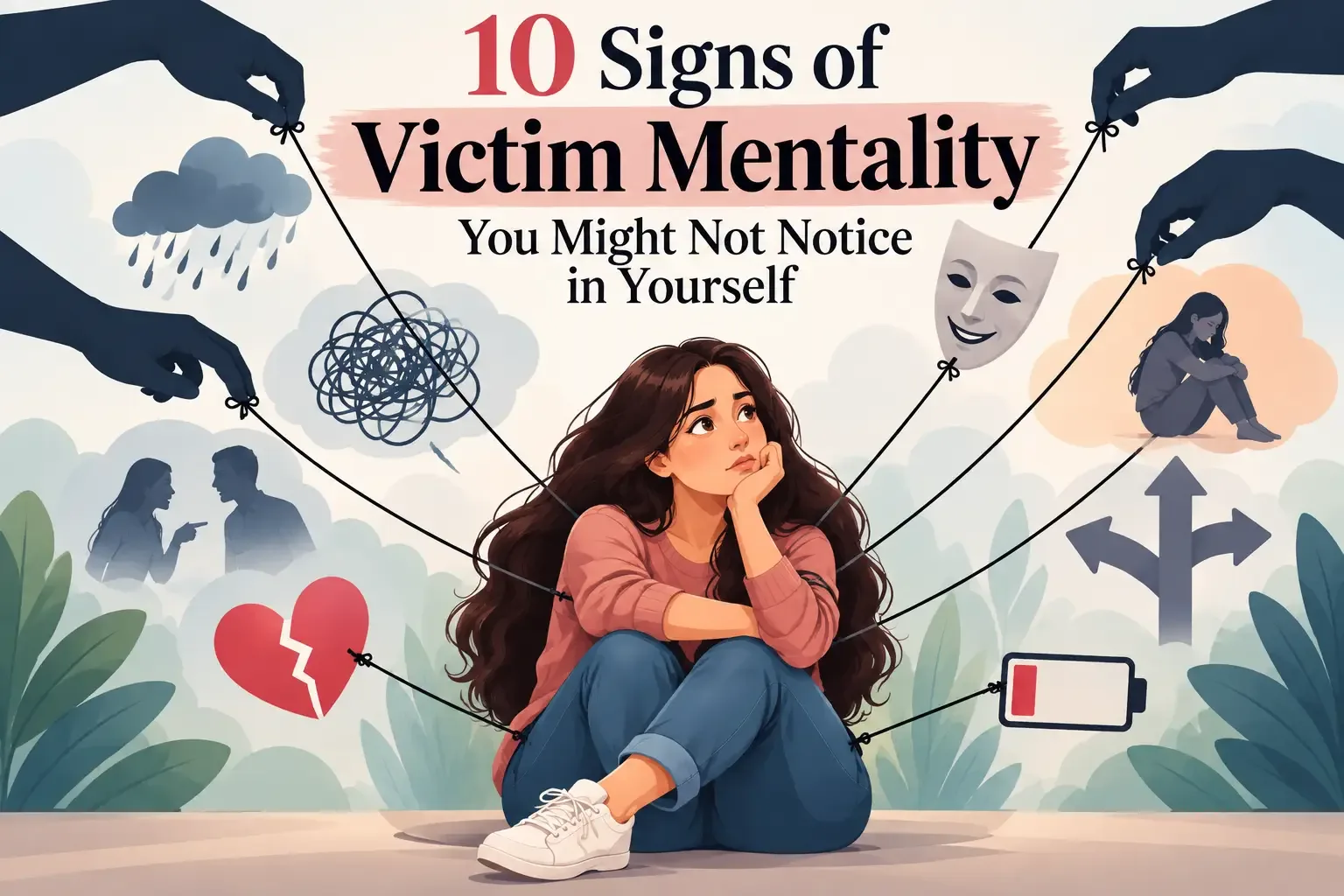
Let us start with something important.
A victim mentality is not the same as being a victim.
Real harm is real. Injustice is real. There are people in genuinely difficult circumstances (financially, relationally, structurally) who are not operating from a victim mentality. They are operating from constrained reality, and conflating the two is both intellectually dishonest and unkind.
What we are talking about here is something different: a habituated psychological pattern, a lens through which all of life gets filtered, in which a person consistently experiences themselves as powerless, wronged, and exempt from responsibility for their own circumstances, even when that is no longer an accurate description of their situation.
The tricky part, and the reason this article exists, is that victim mentality rarely announces itself. It doesn't walk in loudly wearing its label. It whispers. It hides inside thoughts that feel entirely reasonable. It disguises itself as self-awareness, as sensitivity, as honesty.
Because this pattern usually begins as a protective response formed early in life, approaches like Inner Child Therapy can help you understand where it started and how to move through it.
Here are ten of its most common disguises.
You have become extraordinarily skilled at identifying obstacles. Before a new idea has had any real chance of being tested, you have already catalogued every reason it won't work: the timing is wrong, the resources aren't there, people won't understand, it never works for people like you.
This isn't strategic caution. It's a pre-emptive defence against the risk of trying and failing, wrapped in the language of realism.
Notice: the energy you spend justifying inaction is often greater than the energy the action would have required.
Everyone has difficult seasons. What distinguishes a victim mentality pattern is the interpretation: that difficulty is not random or situational, but specifically, personally directed. That life is somehow harder for you than it is for others. That you are the particular target of misfortune, repeatedly.
Research on what psychologists call the self-serving bias (Mezulis et al., 2004) shows that most people attribute positive outcomes to their own actions and negative outcomes to external forces. Victim mentality takes this tendency to an extreme: external forces account for almost everything, and the narrative becomes self-sealing. Evidence that confirms the belief is noticed, evidence that contradicts it is dismissed.
When a colleague gets promoted, when a friend's business takes off, when someone you know achieves something you've wanted, does it feel like information about their path, or does it feel like information about yours? Specifically, does it feel like the world is giving to them what it is withholding from you?
This experience, in which others' gain is felt as personal diminishment, is one of the more painful markers of victim mentality, because it makes genuine connection and celebration difficult. It also tends to generate resentment that, over time, damages relationships without the person quite understanding why.
Here is a subtler one. Over-apologising (reflexive, automatic apologising for things you didn't do, didn't cause, and aren't responsible for) can be a form of victim mentality operating in reverse.
It looks like self-effacement. But underneath it is often a deep belief that you are, by default, in the wrong. That your presence is an inconvenience. That you are always, at some level, at fault.
This is the internalised version of the victim narrative: not "the world is against me" but "I am the problem." Both involve a removal of genuine agency, just from different directions.
There is a difference between feedback that is genuinely unkind or unfair, and feedback that is difficult to receive because it touches something real. The victim mentality often makes this distinction hard to access.
When criticism, even well-intentioned, specific, actionable criticism, lands as an attack, as evidence of being misunderstood, as proof that the other person doesn't recognise your effort or your circumstances, it is worth pausing. Is this feedback actually unfair? Or is the difficulty in receiving it telling you something about how you understand accountability?
Resentment, the sustained, low-level experience of having been wronged, of injustice unacknowledged, of something that should have been different, is one of the most reliable markers of victim mentality.
It differs from anger in important ways. Anger is acute, directional, and when processed, tends to complete itself. Resentment is chronic, diffuse, and self-sustaining. It feeds on the repeated revisiting of the original grievance, and it rarely resolves on its own because it is not primarily about the original event. It is about the meaning that has been constructed around it.
Psychologist Harriet Lerner, in The Dance of Anger (1985), notes that resentment functions as a signal, but one we often misread. It tells us something is wrong. But what is wrong is not always what we think it is.
Decisions can be frightening when you operate from a victim framework, because decisions involve ownership, and ownership involves the possibility of being responsible for things going wrong. It is often much more comfortable to let someone else decide, and then to respond to the outcome as something that was done to you.
This is not laziness. It is a protection. If you didn't choose it, you can't be blamed for it. The cost is agency, and the progressive narrowing of a life in which very little is actually yours.
There is a difference between genuine systemic disadvantage (which is real and should be named) and the consistent, habitual minimisation of your own role in the outcomes of your life.
Victim mentality involves a kind of selective accounting: circumstances and other people are credited with difficulty; your own choices, responses, and patterns are rarely examined with the same rigour. This is not always conscious. It is often a deeply embedded self-protective mechanism, because examining your own contribution requires a degree of vulnerability and accountability that can feel genuinely dangerous.
You notice, clearly and quickly, when others don't follow through, when they let you down, when their behaviour falls short. Your tracking system for others' failings is precise. Your tracking system for your own is somewhat more generous.
This asymmetry is one of the more uncomfortable signs to sit with, because it requires honesty about a double standard. And yet it is one of the most useful to examine, because the gap between what we expect of others and what we extend to ourselves is often where the most significant work lives.
There is something very human about wanting to be seen in your difficulty. To have someone acknowledge the weight, the effort, the sacrifice. This longing is not pathological.
What becomes a pattern worth examining is when the acknowledgment never comes, because it is never asked for directly, or because no acknowledgment ever feels like enough, or because the carrying itself has become the identity, and the waiting becomes a permanent condition.
If you find yourself consistently feeling unseen in your suffering, it is worth asking: have you named what you need? Have you asked directly? Or has the expectation become that the right people should simply know?
None of these patterns are arbitrary. None of them developed for no reason.
The victim mentality, in virtually every case I have encountered, is a protective structure that formed in response to real experiences of powerlessness, usually in childhood, when powerlessness was not a perception but a fact.
The child who had no control over their circumstances, who was hurt by people they depended on, who learned that effort didn't reliably produce different outcomes, who adapted to a world that felt fundamentally unfair: that child's adaptations were intelligent.
The problem is that adaptations designed for a specific context tend to generalise. What protects you then gets applied everywhere. The nervous system doesn't automatically update its threat assessments just because the circumstances have changed.
In therapeutic terms, particularly in Inner Child work, what presents as a victim mentality in an adult is often a younger part of that person still operating from the conditions of their original wound. Still believing that the world works the way it worked then. Still braced for the helplessness that was real, once.
Recognising the pattern is not about judgment. It is about understanding, and from understanding, choosing something different.
If several of these signs resonated with you, the most useful first step is not to judge yourself for them. It is to become curious about them.
When did this pattern start? What was happening in your life when you first learned that this way of interpreting the world made sense? What would it mean, and what would it require of you, if you were more powerful than this framework allows?
These are not always comfortable questions. But they are the questions that lead somewhere different.
Common victim mentality signs include explaining why things can't change before trying, feeling repeatedly singled out by bad luck, resenting other people's success, over-apologising, struggling with constructive feedback, holding onto chronic resentment, avoiding responsibility for outcomes, and waiting for others to notice how much you carry.
Being a victim means real harm or injustice happened to you. Victim mentality is a habitual lens in which you consistently see yourself as powerless or wronged, even in situations where you do have choices or influence. The first is about events; the second is about an ongoing interpretation of life.
No. The victim mentality is not a formal diagnosis. It is a pattern of thinking and relating that can develop as a protective response to earlier experiences. It can overlap with anxiety, low self-worth, or unresolved trauma, so if it feels heavy or affects daily life, speaking with a qualified professional is worthwhile.
It often forms in childhood, when a person genuinely had little control over their circumstances or was hurt by people they depended on. The mind adapts by learning that effort doesn't change outcomes, and that adaptation can continue into adulthood long after the situation has changed.
Yes, and this is very common. The victim mentality rarely feels like a mindset from the inside. It tends to feel like honesty, sensitivity, or realism, which is why the signs are easy to miss in yourself even when they are obvious to others.
It can create distance over time. Constant resentment, difficulty accepting feedback, and comparing your life to others' successes can leave partners, friends, and colleagues feeling blamed or unable to connect with you, even when that is not your intention.
Yes. Because it is a learned pattern and not a fixed trait, it can be shifted. It usually begins with curiosity instead of self-judgment: noticing the pattern, understanding where it started, and gradually practising ownership in small, safe steps.
It can. Inner Child work looks at the younger part of you that learned to feel powerless and helps you meet that part with understanding. Working with the original wound, not just the surface behaviour, often makes lasting change more possible.
Recognising victim mentality signs in yourself is not an accusation. It is an act of honesty, and it takes real courage. These patterns did not appear out of nowhere. They formed to protect you at a time when protection was needed, and they made sense then.
What matters now is whether they still serve you. If several of the ten signs felt familiar, treat that as information, not a verdict. Start with curiosity, look at where the pattern began, and move toward choices that give you back a sense of agency, one step at a time.
• Mezulis, A.H. et al. (2004). Is there a universal positivity bias in attributions? A meta-analytic review of individual, developmental, and cultural differences. Psychological Bulletin, 130(5), 711–747.
• Lerner, H.G. (1985). The Dance of Anger. Harper & Row.
• Seligman, M.E.P. (1975). Helplessness: On Depression, Development, and Death. W.H. Freeman.
• Van der Kolk, B. (2014). The Body Keeps the Score. Viking.
Recognising these patterns is the first step. If you'd like support in understanding where they began and how to move through them, Inner Child therapy offers a compassionate, structured path forward.