

caregiver burnout
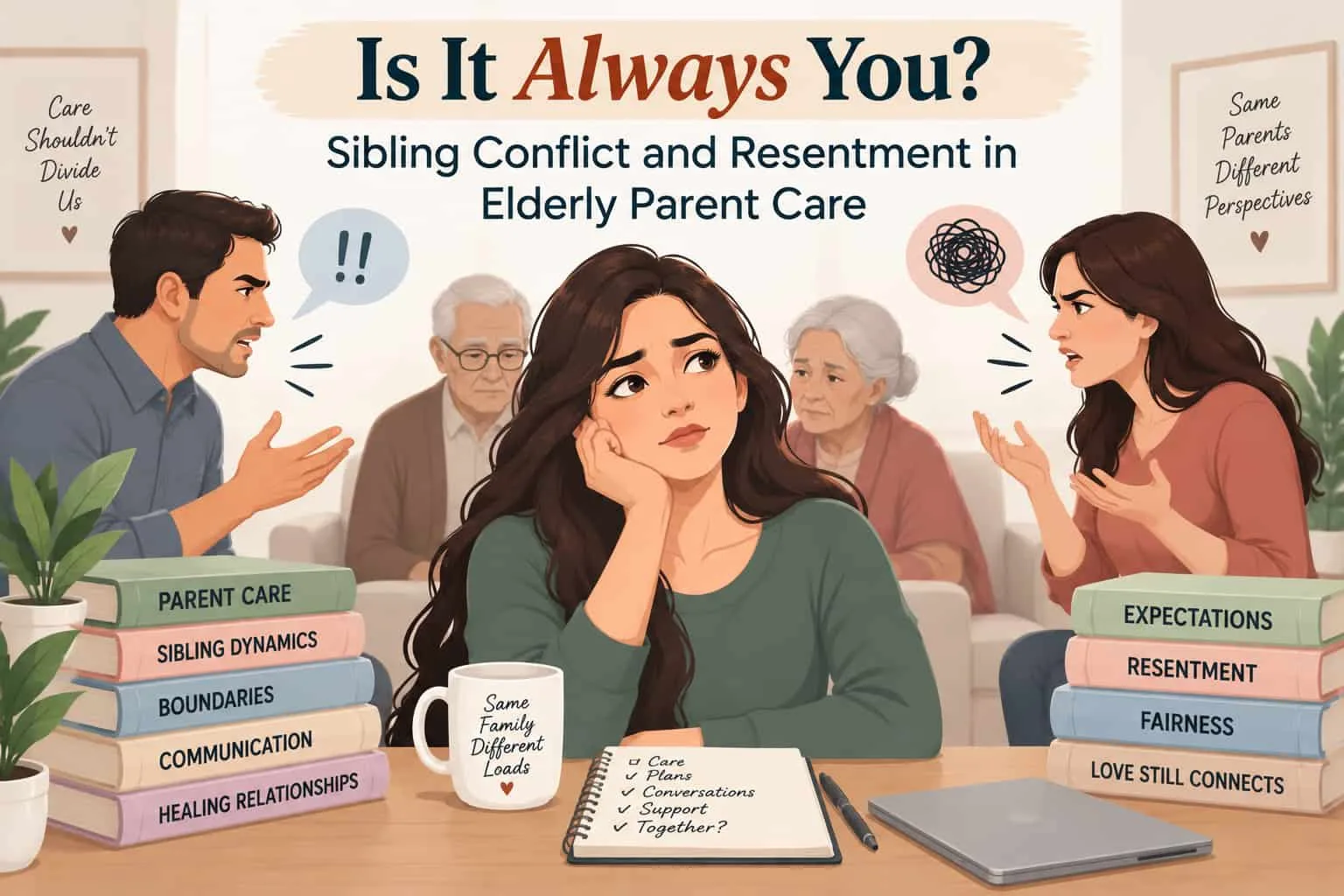
Is It Always You? Sibling Conflict and Resentment in Elderly Parent Care
When elder care falls on one sibling, resentment builds fast. Discover why the burden splits unevenly, and what can actually help
17 September 2026
Introduction
You know the dynamic. One sibling, probably you, since you are reading this, is doing the majority of the organising, attending, coordinating, and emotionally managing. The other siblings are, to varying degrees, absent: physically, practically, or emotionally. And alongside the exhaustion, something else has been building: a resentment that is sharp enough to cut, and a shame about the resentment that arrives almost immediately after it. This situation, one sibling carrying the disproportionate burden of elderly parent care while others remain largely uninvolved, is extraordinarily common. It is also one of the least discussed sources of sibling estrangement and family rupture in midlife and one that often calls for family systems therapy to actually resolve, rather than just manage. This article is an attempt to take it seriously.
Why Caregiving Falls Unevenly
The distribution of elder care responsibility among adult siblings is rarely random. Research in family systems consistently identifies structural and relational factors that predict who carries the burden: Geography. The sibling who lives closest tends to carry more, often significantly more, regardless of agreed-upon arrangements. Proximity becomes default responsibility. Gender. Across cultures and income levels, daughters carry more elder care than sons: more hours in direct care, more emotional labour, more coordination work. A landmark study by the National Alliance for Caregiving found that daughters were twice as likely as sons to be primary caregivers to ageing parents. Birth order. Firstborn and eldest daughters disproportionately assume caregiving roles, an extension of the caretaking and responsibility patterns established earlier in the family. The family system's established role structure. Family systems, as Murray Bowen's work established, tend toward homeostasis, maintaining established patterns even as circumstances change. The sibling who was always "the responsible one" continues to be the responsible one in the caregiving context. The sibling who was always "the one who needed things managed for them" continues in that position, often without conscious awareness from anyone involved.
What the Conflict Is Really About
On the surface, sibling conflict about elderly parent care is about practical inequity: who is doing more, who is absent, who should be contributing more and who isn't. Underneath, it almost always activates much older material: The question of whose needs counted. In most families, the distribution of parental attention, resources, and emotional investment was not perfectly equal. The sibling conflict in elder care is often, at a deeper level, a continuation of a much older argument about fairness, visibility, and whose experience was acknowledged and whose was not. Old alliance and coalition patterns. The sibling who was always the parental favourite, the one who always got away with things, the one who was always excused, these patterns do not disappear in adulthood. They often intensify in the caregiving context, where the stakes are higher and the parental figures are still present. Unexpressed grief and fear. The ageing and potential loss of a parent activates the full history of each sibling's relationship with that parent. Each sibling is grieving a different relationship. The conflict between them is sometimes the collision of those different griefs.
The Resentment Is Legitimate
The resentment of the primary caregiver toward absent siblings is legitimate. This needs to be said clearly, because the caregiver typically spends enormous energy managing the resentment rather than acknowledging it. You are doing more. That is a fact. The inequity is real. The practical, physical, and emotional cost to you is real. The cost to your career, your health, your relationships, and your own life is real. Resentment does not mean you love your parents less than your siblings do. It means you are the one who has been showing up while they are not, and that the absence has consequences that you are carrying.
What Can Actually Help
Have a direct conversation, specifically, practically. The conversation that is most avoided and most needed: a clear, specific discussion of what the current distribution of responsibility is, what the realistic needs of the parent are, and what each sibling can concretely commit to going forward. Not a conversation about feelings first; a practical one. Feelings will be present regardless. Structure the conversation around specifics. Lower the standard for how care is delivered. Much of the burden concentration happens because the primary caregiver has specific standards for how things should be done, and manages tasks themselves rather than letting another sibling do them imperfectly. The question: is perfect care worth your complete depletion? What could be released to another person, done differently, without genuine harm? Address the systemic dimension. The caregiving role distribution is rarely created in the current situation. It is the latest expression of a pattern that has been running for decades. Understanding it as systemic, as a family pattern that pre-dates and shapes the current conflict, can reduce the personal charge of resentment and open the possibility of addressing it differently. Find support outside the family system. Therapy, individual or family, provides the one thing the caregiving context consistently denies: an outside perspective that can see the system clearly enough to name what is happening and support something different.
References
Bowen, M. (1978). Family Therapy in Clinical Practice. Jason Aronson. National Alliance for Caregiving & AARP (2020). Caregiving in the US. Hellinger, B. (1998). Love's Hidden Symmetry. Zeig, Tucker & Co. Boszormenyi-Nagy, I. & Sparks, G.M. (1973). Invisible Loyalties. Harper & Row. If the patterns in your sibling dynamic feel older and deeper than the current caregiving situation, Family Constellation therapy offers a framework for understanding and shifting what the family system has established. Contact us.
FAQs
Yes. Resentment toward absent siblings is a legitimate response to a real and ongoing inequity, not a sign that you love your parents less or that something is wrong with you
Keep the first conversation practical rather than emotional. Focus on specifics: current responsibilities, the parent's actual needs, and what each sibling can realistically commit to, instead of opening with feelings.
Ageing parents and the fear of losing them tend to reactivate childhood roles and unresolved family dynamics, including old favouritism, competition, or unacknowledged grief, that never fully went away
Yes. An outside perspective, especially through approaches like Family Constellation therapy, can name the deeper family pattern driving the conflict, rather than just addressing the surface-level disagreement
You can't force involvement, but you can lower your own standard for "perfect" care and get outside support so the entire weight doesn't fall on you alone, even if the caregiving imbalance itself doesn't change.
It usually comes down to a mix of geography, gender, and old family roles. The sibling who lives closest, or who was always seen as "the responsible one," tends to default into the caregiving role, regardless of what was actually agreed on.
Keep reading