
caregiver burnout

How chronic stress and unresolved emotion show up as headaches, gut issues, skin flare-ups, chronic pain and fatigue, and what actually helps.
22 September 2026
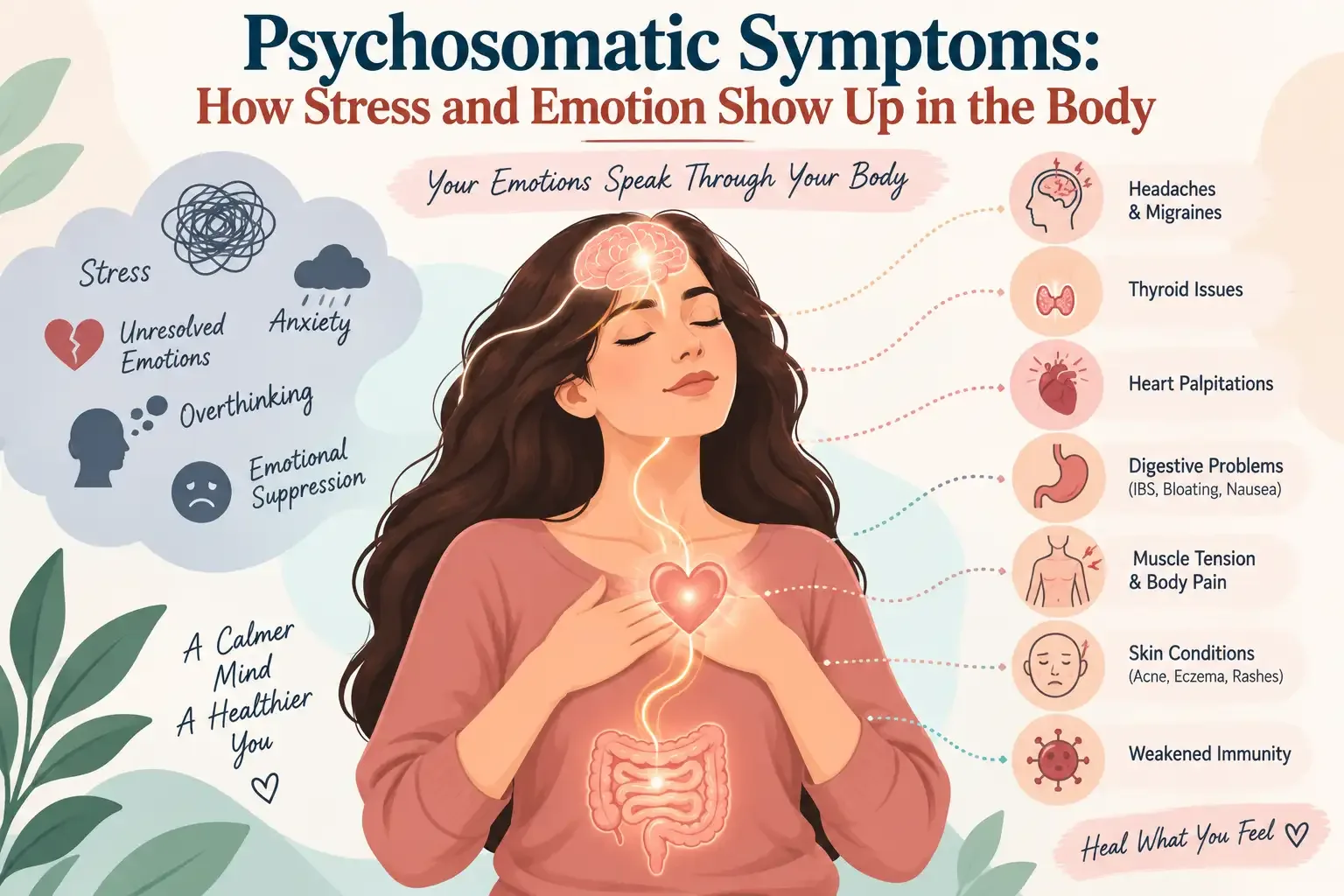
The body has a way of speaking before we find the words for it. Long before we can say "I'm overwhelmed" or "I'm grieving," the body has usually already said it, through tension in the jaw during a stressful week, a migraine that arrives every Sunday evening, or a stomach that knots up before a hard conversation. These are psychosomatic symptoms, the body's way of expressing what the mind and emotions are carrying. They are not imaginary. They are real and often measurable, arising from, or strongly influenced by, psychological and emotional states rather than purely structural or disease related causes. Approaches like Access Bars work with exactly this connection, helping the nervous system release what it has been holding onto.
Tension headaches, that familiar band of pressure across the forehead and temples, are among the most reliably psychosomatic complaints there are. They come from sustained muscle tension in the neck, scalp and shoulders, almost always driven by stress. Migraines are more complicated, involving hormones and neurology too, but emotional stress is consistently flagged as one of the biggest triggers.
IBS, functional dyspepsia, chronic nausea, bloating and irregular bowel habits are some of the most studied psychosomatic conditions there are. The gut has its own nervous system, sometimes called the second brain, in constant two way contact with the brain through the vagus nerve. Stress changes gut motility, sensitivity and immune activity almost directly, which is why psychological approaches like CBT and gut directed hypnotherapy often help where medicine alone falls short.
Psoriasis, eczema, rosacea, hives and acne all tend to flare up under stress. Skin and the nervous system develop from the same embryonic tissue, which may explain why they stay so closely linked. Stress raises cortisol, cortisol drives inflammation, and inflammation shows up on the skin.
Back pain, neck pain, fibromyalgia and widespread chronic pain often carry a large psychosomatic component. Dr. John Sarno's work at NYU Medical Centre found that most of his chronic back pain patients had no structural problem serious enough to explain their pain, yet nearly all had unresolved emotional tension, and the pain eased once that tension was addressed.
Fatigue that doesn't lift no matter how much you sleep is one of the most common, and most overlooked, psychosomatic symptoms. When the nervous system stays switched on, whether from chronic stress or emotions that never got processed, the body's ability to recover gets blocked. Rest stops working because the system never fully drops into the state where real recovery happens.
Palpitations, tightness in the chest and unexplained high blood pressure often show up with no cardiac disease behind them. Takotsubo syndrome, sometimes called broken heart syndrome, where intense emotional distress triggers acute heart dysfunction, is one of the clearest examples of emotion affecting the heart directly.
Getting sick often, healing slowly, or having an autoimmune condition flare up after a stressful period are patterns well documented in psychoneuroimmunology research. Cortisol suppresses immune function during stress and then overcorrects once it passes, and that back and forth plays a part in the imbalance seen in autoimmune disease.
A few patterns are worth noticing. Your symptoms line up, again and again, with emotional stress or specific relationships, even if the connection takes a few days to show. They haven't fully improved with proper medical treatment, or they shift in ways your diagnosis doesn't quite explain. They started around the same time as something big happened, a loss, a breakup, a major transition. None of this means the pain isn't real. It usually just means there is more than one piece to the puzzle.
A psychosomatic lens does not replace medical care, it adds to it. Therapy, especially body focused approaches, EMDR, mindfulness based stress reduction and somatic experiencing all have solid evidence behind them. Access Bars, offered at The Healing Room, works directly with the nervous system's accumulated charge, helping the body move out of a stressed state and into genuine parasympathetic activation, the state in which physical healing actually happens.
The body isn't working against you when it produces these symptoms, it is communicating. A tension headache, a flare of eczema, a stomach that won't settle, none of these are failures of the body, they are signals. Learning to read them changes the question from what's wrong with me to what is this trying to tell me, and that shift alone can be the beginning of real relief. If you've been chasing a diagnosis for months without an answer, it may help to look at what's happening underneath the symptom and not only at what shows up in it.
They are physically real and measurable. The term simply means emotional states play a significant role in causing or worsening them, not that they are imagined.
Yes. Sustained stress keeps muscles tense and raises cortisol and inflammation, changing how the nervous system processes pain signals.
It varies. Symptoms can appear almost immediately, or surface days or weeks later, which is part of why the connection often goes unnoticed.
Yes, always. This approach works alongside medical care, not instead of it. Ruling out underlying medical conditions first is essential.
Access Bars is a gentle hands on technique that works with points on the head connected to areas of thought and emotion, helping release accumulated charge and shift the nervous system out of a stress response.
Headaches, digestive issues, skin flare ups, chronic pain, unexplained fatigue and heart palpitations are among the most commonly reported.
Many people see significant, lasting improvement once the underlying emotional factor is addressed, especially alongside appropriate medical treatment.