
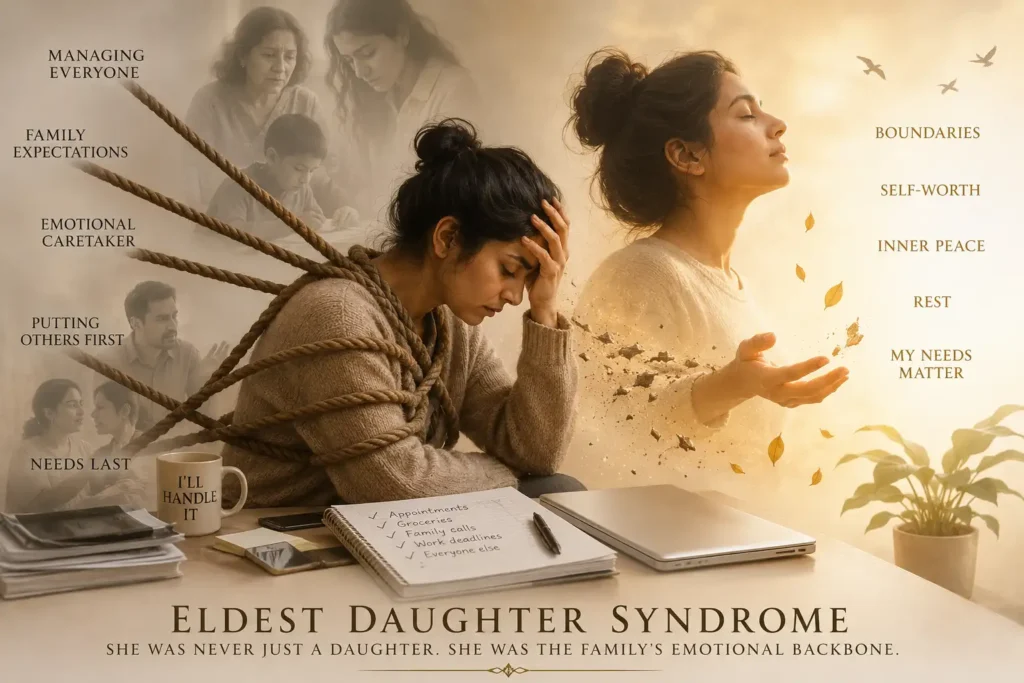
Eldest Daughter Syndrome: She Was Never Just a Daughter She Was the Family's Emotional Backbone
Understanding Eldest Daughter Syndrome: the invisible weight that high-achieving, exhausted women have been carrying since childhood.
Priya is 34. She is successful, reliable, and the first person everyone calls in a crisis. At work, she manages her team with quiet efficiency. At home, she coordinates her parents’ medical appointments, mediates her younger siblings’ conflicts, and still somehow finds time to send birthday messages to every relative. She has not taken a real holiday in four years. She cannot explain why saying no feels physically dangerous. She does not know when she stopped having needs of her own – only that it happened a very long time ago.
Priya is not a superhero. She is an eldest daughter living with what psychologists now call Eldest Daughter Syndrome – and she is exhausted in a way that sleep cannot fix.
What Is Eldest Daughter Syndrome?
Eldest Daughter Syndrome is not a clinical diagnosis. It is a pattern, named and increasingly recognised in psychology, that describes the particular emotional labour assigned to firstborn daughters in families. Unlike eldest sons, who are often granted authority, eldest daughters are typically assigned responsibility without power expected to nurture, mediate, manage, and hold the family together, emotionally, practically, and sometimes financially, often from a very young age.
This pattern is closely linked to what psychologists call parentification: a role reversal where a child takes on adult-level emotional or caregiving duties before they are developmentally ready for them.
The mechanisms that create this pattern are deeply embedded in family systems. When parents are overwhelmed by financial stress, marital tension, immigration, illness, or their own unprocessed trauma they unconsciously lean on the most capable child. In most family structures, that child is the eldest daughter. She is old enough to help, young enough to mould, and, crucially, she has learnt that being needed is how she is loved.
Research published in the Journal of Family Psychology found that firstborn children, and particularly firstborn daughters, score significantly higher on measures of conscientiousness, anxiety, and responsibility than their younger siblings traits shaped not by genetics, but by family role.
5 Signs You Might Be Living With Eldest Daughter Syndrome

Not every firstborn daughter carries this pattern, and it can show up in second daughters or “default” caretakers too. Here is what it often looks like day to day:
- You feel responsible for other people’s emotions. A parent’s bad mood or a sibling’s crisis feels like your job to fix.
- Rest feels earned, never automatic. You cannot relax until every task is done and the list never ends.
- Saying no triggers guilt or even physical anxiety. People-pleasing women often describe this as a felt sense of danger, not just discomfort.
- You are the family’s default project manager. Appointments, conflicts, logistics, emotional check-ins all route through you.
- You struggle to name your own needs. When someone asks “what do you want,” you genuinely don’t know.
The Story She Tells Herself
The eldest daughter rarely sees her situation clearly, because the lens through which she views herself was grounded in childhood. She does not think I was parentified. She thinks I am just capable. She does not think, I was never allowed to need anything. She thinks I am not really a needy person.
This is the cruelty of the pattern: it disguises itself as character. The hyper-responsibility feels like virtue. The inability to rest feels like driving. The people-pleasing feels like kindness. It takes considerable courage to look beneath the identity and ask: what did I have to become, in order to be safe in this family?
The Body Keeps the Score: Physical Symptoms of Eldest Daughter Syndrome
The physical toll of carrying this role is real and well-documented. Eldest daughters present in therapy and healing spaces with a strikingly consistent set of symptoms: chronic fatigue, anxiety, difficulty sleeping, tension in the shoulders and neck, digestive issues, and an immune system that crashes the moment they finally stop moving.
The body, which has been running on duty and adrenaline for decades, does not know how to shift gears when the coast is clear. Rest feels irresponsible. Stillness feels dangerous. The nervous system, calibrated to vigilance, remains on high alert even in safety.
A 2019 study in Psychological Science found that individuals who were parentified in childhood given adult emotional responsibilities prematurely showed significantly elevated cortisol levels and greater reactivity to stress in adulthood
What Family Constellation Reveals About the Eldest Daughter Role
In Family Constellation work, the eldest daughter often appears in the same systemic position: standing in for a parent, carrying emotions that belong to someone else, unable to take her own place in the family order because she has been occupying someone else’s. The work is not about blaming the family. It is about making visible what has been invisible, so that she can, perhaps for the first time, simply be a daughter.
The moment that moves clients most in the constellation is often simple: when they are given permission to put down what they have been carrying and step back into the child’s position. Many weep. Not from sadness exactly, but from the shock of relief of finally being small enough to be held, rather than large enough to hold everyone else.
What Recovery From Eldest Daughter Syndrome Looks Like
Healing from Eldest Daughter Syndrome is not about becoming selfish. It is about becoming whole. It involves learning to distinguish between what is genuinely yours to carry and what was placed on you before you were old enough to consent. It involves, slowly, building a relationship with your own needs, which have not disappeared, only gone underground.
It means practising the radical act of receiving help, rest, care, love without immediately looking for how to repay it. It means understanding that your value is not contingent on your usefulness. That you were not born to be the family’s emotional infrastructure. That somewhere beneath the capable, reliable, endlessly available woman is a girl who also needed someone to ask how she was doing.
“You cannot pour from an empty vessel. But you also deserve to be a vessel that is filled.”