
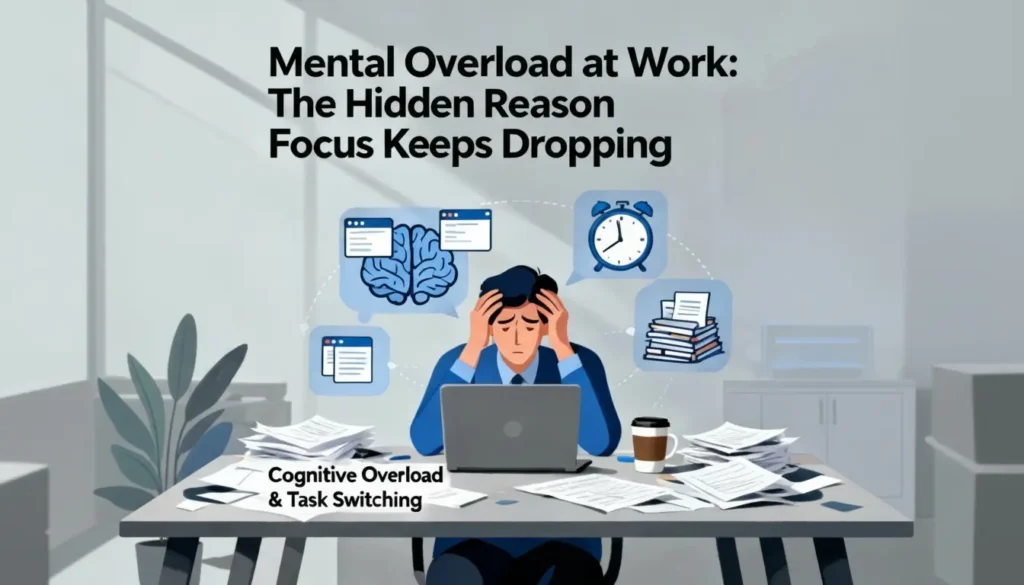
Mental Overload at Work: The Hidden Reason Focus Keeps Dropping
Mental overload at work is one of the biggest hidden reasons people struggle to focus—yet most don’t realize it. If you’ve been staring at your laptop for 20 minutes and still haven’t started the task you opened, you’re not alone. Many people assume that losing focus means they’re lazy, unmotivated, or simply “not disciplined enough.” But in most modern workplaces, the truth is far more human—and far more common.
The real issue is often Mental Overload at Work.
It’s that invisible weight on the mind that builds up silently through constant tasks, meetings, notifications, decisions, and pressure to perform. And once mental overload sets in, your focus doesn’t disappear because you don’t care—it drops because your brain is already full.
Let’s unpack what’s really happening and how you can fix it.
What Mental Overload at Work Actually Means
Mental overload is not the same as stress. Stress is an emotional response to pressure. Mental overload is more like your brain’s capacity hitting its limit.
Think of your mind like a computer.
- When too many tabs are open, the system slows down
- It doesn’t matter how powerful the laptop is-capacity is capacity
- Eventually, performance drops
That’s exactly what happens with Mental Overload at Work. Your brain is trying to process too much information at once: deadlines, messages, expectations, social interactions, task switching, and internal self-talk.
Even if you’re physically sitting still, mentally you’re running a marathon.
Why Focus Drops When the Mind is Overloaded
Focus is not just a “skill.” It’s a mental resource.
When you’re overloaded, focus drops for very predictable reasons:
Your brain gets stuck in survival mode
When the workload feels never-ending, your brain prioritizes scanning for threats (what’s urgent, what’s pending, what’s next). That makes deep focus almost impossible.
Task-switching drains your attention
Every time you jump between emails, WhatsApp, meetings, and documents, your brain pays a switching cost. By afternoon, your mind is exhausted even if you didn’t “do much.”
Decision fatigue consumes willpower
A typical workday is filled with micro-decisions: replying, prioritizing, choosing words, planning tasks, solving issues. The result? Your brain has less power left for actual focus.
Signs You’re Dealing with Mental Overload at Work
Sometimes mental overload shows up in subtle ways. Here are some of the most common signs:
- You read the same sentence multiple times without absorbing it
- You start tasks late even when you want to work
- You forget small things (passwords, names, follow-ups)
- You feel busy but unproductive
- Your mind feels “noisy” even during quiet moments
- You feel irritated over small interruptions
- You keep checking your phone even without a reason
If you relate to several of these, there’s a good chance your focus problem isn’t motivation-it’s overload.
The Hidden Triggers That Create Mental Overload at Work
Here’s why today’s workplace is the perfect environment for cognitive overload:
Constant availability culture
Many employees feel they must be reachable all the time. That creates background mental pressure-even during breaks.
Too many tools, too many channels
Email, Slack, Teams, WhatsApp, CRMs, project trackers… each platform adds “mental tabs” that stay open in your head.
Back-to-back meetings
Meetings don’t just take time. They take cognitive energy. And if there’s no space between meetings, your brain never resets.
Perfectionism and people-pleasing
This is a big one. When you’re trying to be “good” at everything—responding quickly, doing things perfectly, meeting expectations-mental load doubles.
How to Reduce Mental Overload and Get Focus Back
The good news? Focus can return quickly once you reduce the load.
Here are practical strategies that work-without needing a complete life reset.
1) Use the brain-dump method daily
Take 5 minutes to write everything in your head on paper or notes.
Not goals. Not plans. Just everything you’re carrying mentally.
This simple habit reduces internal clutter and gives your brain breathing room.
2) Follow the 3-priority rule
Instead of a to-do list of 20 items, decide:
- Top 1 must-do task
- Top 2 important tasks
- Everything else becomes optional
This reduces the pressure of “doing everything” and helps your brain commit to fewer targets.
3) Create focus blocks (and protect them)
Pick one time slot daily (even 30 minutes) for deep work.
During this time:
- turn off notifications
- keep phone away
- work on only one task
Focus improves when distractions reduce-not when you try harder.
4) Reduce decision fatigue
Small system changes create huge mental relief.
Try:
- keeping a fixed morning routine
- using templates for repeated work messages
- setting standard work windows for admin tasks
Less deciding = more energy for focus.
5) Reset your nervous system for 2 minutes
Sometimes focus drops because your body is overstimulated, not because the task is hard.
Quick reset options:
- slow breathing (long exhale)
- drink water and step away from screen
- short walk or stretching
- close eyes for 60 seconds
These micro-pauses reduce overload and restore mental clarity.
Mental Overload at Work Isn’t a Personal Failure
One of the most damaging beliefs people carry is:
“If I can’t focus, something is wrong with me.”
But the truth is simpler—and kinder.
Mental Overload at Work is a normal response to an abnormal workload environment. In fact, constant mental fatigue, low focus, and emotional exhaustion are also common Signs of Burnout at Work-especially when overload continues for weeks without recovery.
Your brain isn’t weak. It’s overloaded.
Focus is not fixed. It’s recoverable.
When you lighten the mental load, your mind naturally returns to clarity—without forcing discipline or pushing harder.
Conclusion: Focus Returns When the Mind Becomes Lighter
If your focus keeps dropping, don’t immediately blame yourself. Your brain is likely doing its best while carrying too many invisible responsibilities.
Start small:
- reduce mental tabs
- protect short focus blocks
- build micro-resets
- simplify priorities
Because in reality, the solution isn’t to work harder.
It’s to work with a clearer, lighter mind.
And that begins by understanding Mental Overload at Work for what it truly is: a hidden productivity drain-and a very fixable one.
Frequently Asked Questions (FAQs)
Mental overload at work happens when your brain is processing too many tasks, decisions, and inputs at once. It reduces mental clarity, slows thinking, and makes focus harder even during simple tasks.
Focus drops when your mind is overloaded with constant task-switching, notifications, meetings, and unfinished responsibilities. Your brain runs out of capacity, making deep focus difficult.
Common signs include brain fog, forgetting small things, difficulty starting tasks, re-reading the same content, feeling busy but unproductive, irritability, and mental exhaustion even after rest.
No. Mental overload is a short-to-medium term state where the brain is carrying too much at once. Burnout is a long-term condition involving emotional exhaustion, detachment, and reduced performance over time.
Yes. When your brain is overloaded, it stays in a high-alert state. This can increase stress, anxiety, restlessness, sleep issues, and emotional overwhelm.
Use a 5-minute brain dump, pick only 3 top priorities, turn off notifications for a focus block, and take a 2-minute reset (slow breathing, stretching, or a short walk).
Yes. Multitasking forces your brain to switch contexts repeatedly, which drains attention and increases mental fatigue. Single-tasking improves both productivity and focus.
Some people feel better within a day by reducing inputs and improving structure. Deeper recovery may take a few weeks of consistent habits like focus blocks, better routines, and reduced mental clutter.
Back-to-back meetings, unclear priorities, constant messaging, frequent interruptions, lack of breaks, and pressure to be always available are the biggest drivers of mental overload at work.
Companies can reduce overload by setting no-meeting focus hours, limiting after-hours messages, clarifying priorities, improving workload planning, and offering mental wellness programs that support nervous system regulation.