
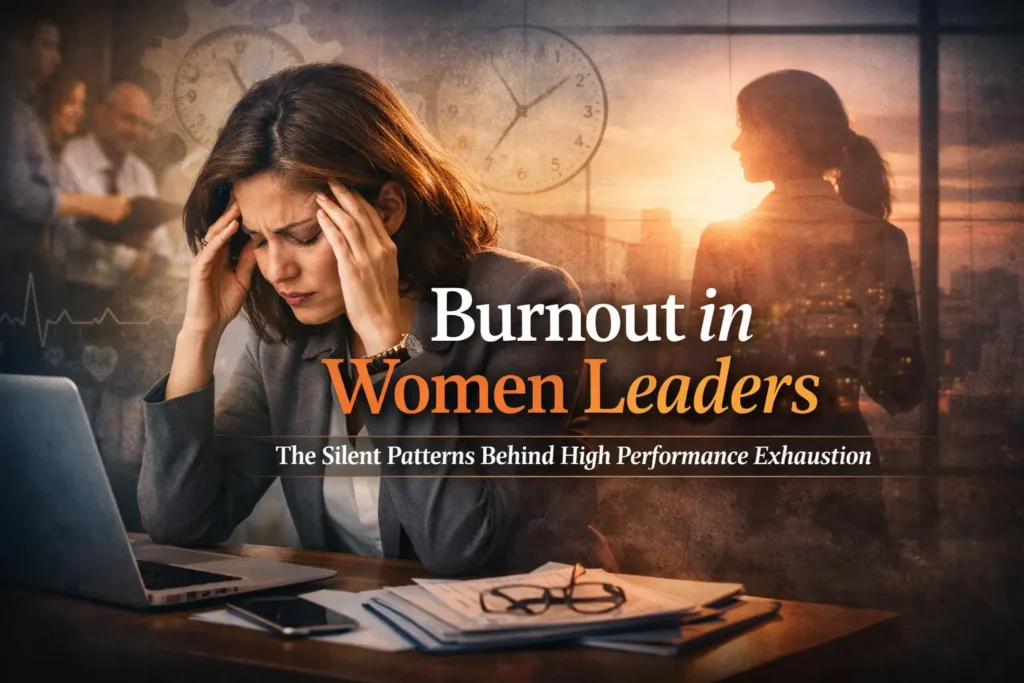
Burnout in Women Leaders: The Silent Patterns Behind High Performance Exhaustion
Explore the hidden emotional and physical patterns of burnout in high-performing women-and how to prevent silent exhaustion before it takes over.
They rise through the ranks.
They lead from the front.
They inspire teams, hold families, manage deadlines, and absorb stress like sponges.
And then one day, they break. Quietly. Invisibly.
This is the story of leadership burnout in women-and it’s far more common than we talk about.
The Silent Epidemic of Burnout in Women Leaders
Burnout isn’t just a buzzword. It’s a real, measurable condition-recognized by the World Health Organization as an occupational syndrome characterized by emotional exhaustion, cynicism, and reduced performance.
But for women in leadership, burnout often hides behind achievement, empathy, and perfectionism.
Unlike the textbook definition, women don’t always collapse under pressure.
They keep functioning.
They stay high-performing.
They smile.
They even mentor others.
And that’s the problem.
Because high-functioning burnout looks deceptively put-together.
Until it doesn’t.
The Patterns We Don’t See - Until It’s Too Late
In our work with senior women professionals across corporates, startups, and institutions, we’ve identified recurring emotional and behavioral patterns that signal burnout. These often go unrecognized, even by the women themselves.
1. Over-responsibility Syndrome
She’s the one who never drops the ball.
Take initiative. Fixes mistakes. Covers for the team.
But beneath this hyper-responsibility lies an unconscious belief: “If I don’t do it, no one will.”
This pattern often stems from childhood roles-being the caretaker, the achiever, the one who keeps peace in the family. In the workplace, it turns into emotional exhaustion masked as “ownership.”
2. Boundary Breakdown
Successful women are often praised for being “available,” “supportive,” or “team players.”
But this comes at a cost.
Saying yes too often.
Taking meetings during personal time.
Feeling guilty for logging off.
Allowing emotional spillovers from team conflicts.
Without boundaries, leadership becomes not just strategic-but personal and draining
3. High-Functioning Anxiety
Externally, everything’s running well.
But inside, she’s rehearsing every conversation.
Second-guessing every decision.
Unable to switch off-even on weekends.
High-functioning anxiety is sneaky-it drives performance but corrodes confidence.
And eventually, it wears the nervous system down.
4. Internalized Pressure to Prove
Many women leaders have had to fight to be seen.
To prove they belong in the boardroom.
To match metrics, confidence, and energy in male-dominated environments.
So they push harder. Stay longer. Take on more.
Even when it costs their health, relationships, or joy.
This unspoken burden of representation leads to chronic burnout-disguised as ambition.
The Emotional Load No One Talks About
Leadership isn’t just strategy, execution, and management.
For women, it often includes emotional labor:
- Mediating between team dynamics
- Softening feedback to avoid being called “aggressive”
- Carrying others’ stress while hiding their own
- Leading with empathy… even when their own tank is empty
This emotional labor is invisible, unpaid, and unrecognized-but deeply taxing.
One senior marketing head once told us, “I don’t mind the work. I just wish someone could hold space for me, the way I do for everyone else.”
That’s the heartbreak of burnout. It’s not always physical-it’s spiritual.
The Body Keeps the Score
When the mind doesn’t rest, the body starts speaking louder.
Women experiencing leadership burnout report:
- Unexplained fatigue
- Hormonal imbalances
- Anxiety attacks
- Chronic back or neck pain
- Digestive issues
- Brain fog and sleep disturbances
These are not just “stress symptoms.”
They are signals.
Signals that the nervous system is overloaded.
That suppressed emotions need release.
That boundaries have collapsed.
That it’s time to pause-not perform.
Why Traditional Wellness Programs Don’t Work?
Generic meditation apps, yoga challenges, or resilience webinars are not enough.
They don’t address the emotional root of burnout.
They don’t understand the gendered reality of leadership fatigue.
And they don’t give women the safe space to be supported without being seen as “weak.”
Women don’t need another “5 tips to relax” newsletter.
They need spaces where they can drop the mask, reset their nervous systems, and reconnect with themselves.
Our Approach: Emotional Resilience for Women in Leadership
At The Healing Room by Treta Foundation, we specialize in deep emotional wellness programs crafted specifically for senior women professionals and leadership teams.
Our Corporate Wellness Programs are not surface-level. They’re transformational.
They combine:
- Emotional resilience tools (for inner calm and decision clarity)
- Family Constellation Therapy (to release inherited pressure and leadership blocks)
- Inner Child Healing (to address perfectionism, people-pleasing, and fear of failure)
- Access Bars and Body Processes (to reset the nervous system and restore balance)
Each program is tailored, confidential, and designed with care-for women who hold so much, and are finally ready to be held.
A New Kind of Strength
Burnout isn’t a personal failure. It’s a collective pattern.
And healing from it doesn’t mean stepping away from leadership.
It means leading differently-from a place of clarity, calm, and embodied power.
You don’t have to wait until you crash.
Let us help you pause, realign, and return to leadership with more joy, energy, and ease.
Ready to Heal the Hidden Burnout?
We offer private consultations, group workshops, and long-term corporate wellness programs.
📩 Explore our Corporate Wellness Offerings
Because leadership should feel light, not lonely.
And burnout doesn’t have to be your story.
FAQs
Burnout in women leaders is a state of emotional, mental, and physical exhaustion caused by prolonged stress, high responsibility, emotional labor, and lack of recovery time.
Many women continue to perform, lead, and support others despite exhaustion. This high-functioning burnout hides behind achievement, making it harder to recognize early.
Common signs include chronic fatigue, anxiety, sleep issues, brain fog, irritability, hormonal imbalance, loss of motivation, and feeling emotionally drained despite success.
Burnout in women often includes emotional labor, people-pleasing, perfectionism, and internal pressure to prove oneself-factors not always addressed in generic stress management.
Yes. Burnout can be prevented through emotional boundary work, nervous system regulation, addressing unconscious patterns, and receiving consistent emotional support.
Most programs focus on surface-level relaxation rather than addressing emotional roots, gendered leadership pressure, and long-term nervous system overload.
Deep emotional healing approaches such as emotional resilience training, inner child healing, body-based therapies, and safe support spaces are most effective.